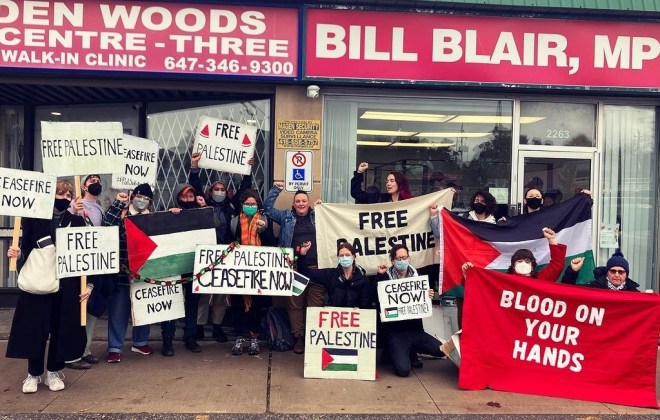
(Feature photo sourced from @surj_toronto Instagram)
More than 600 people joined Take Action for Palestine Webinar hosted by Resource Movement, Independent Jewish Voices, and Standing Up for Racial Justice (SURJ) Toronto on Oct. 24. Though it may have been one tiny drop in an ocean of global solidarity with Palestinian liberation movements, it was packed with seeds of knowledge, and motivation.
Molly, an organizer for SURJ Toronto, explained that the money raised was split between the Palestinian Youth Movement, a transnational grassroots movement of young Palestinians in Palestine and worldwide organizing for the liberation of Palestine and Palestinian people, and humanitarian aid for Gaza being collected by Canadians for Justice and Peace in the Middle East.
Rose, another organizer with SURJ Toronto, started the meeting with a land acknowledgement, encouraging people to acknowledge and reflect upon the history of the land they were Zooming in.
“Indeed, our fervent desire for Palestinian liberation that brings us here today creates an opportunity for us to think critically about why we do land acknowledgements,” Rose said. “When gathering on colonized lands, it is important that we reflect on how the ongoing legacies of settler colonialism structure our contemporary world and continue to displace and violate the rights of indigenous peoples worldwide.”
She said the commitment to Palestinian liberation being brought forward by activists informs the understanding of the fact that many of the same tactics used by the Israeli government have been integral to the creation of Canada and other settler colonial nation-states.
“So, I just ask that may we take this moment to acknowledge how we are all implicated in this history as we let our grief and rage strengthen our solidarity with indigenous peoples worldwide from Turtle Island to Palestine,” Rose said.
Molly gave background to the motivations of the groups involved in organizing the webinar. Resource Movement organizes young people with wealth or class privilege towards redistributing wealth, land and power. Independent Jewish Voices is a grassroots organization grounded in Jewish traditions that opposes all forms of racism and advocates for justice and peace for all in Israel and Palestine. SURJ Toronto is a GTA-based grassroots organization and a local chapter of a broader U.S. network. SURJ believes no one is free until everyone is free, and they focus on organizing White people into taking anti-racist action.
“Maybe you are thinking, what brings us as organizations together this evening and why are we … invested in Palestinian liberation,” Molly said. “In the simplest sense, we are coming together because of the unfolding horrors of genocide being committed by the Israeli state against Palestinian people in Gaza. We say unequivocally it must end. As organizations, we are invested in justice, peace, and challenging power. This means staring squarely at the Israeli occupation, Israeli Apartheid, and … 16 years of a brutal and inhumane blockade on Gaza. The tormenting and unrelenting rule of Israeli dehumanization towards Palestinians and saying clearly in a chorus that cannot be denied, we will not sit by as this happens.”
She said people with wealth and class privilege have an opportunity to shift conversations and perspectives and move money to causes that are sidelined in so much of the mainstream Western culture.
“White folks invested in anti-racist struggles – we have a role to play in saying that all forms of racism must be challenged,” Molly said. “Colonial occupations must be dismantled. From Turtle Island to Palestine, occupation is a crime.”
She called on white Christians to get involved.
“You have a very powerful role to play in working with other Christian folks to look closely at the roots of the Zionist project as you work to challenge it,” she said. “The Zionist project is a story of global colonial power and legacy … and challenging it also offers a window into the way antisemitism was present in its creation and persists with so many Christian Zionist communities today.”
Molly paused to take a deep breath to ground herself before speaking to the people of Jewish descent who were online.
“I’m the granddaughter of two Holocaust survivors,” she said. “My aunt and all my grandparent’s families were killed in the Holocaust. I know in my bones what genocide means to a family, to a lineage and to the ongoing intergenerational trauma that my family carries.”
“I come to this work invested in my healing and in refusal to allow this nightmare violence to happen in my name. I imagine that there are many Jews here that can relate. We reject the divisive white supremacist logic that underpins Israeli statehood. Israel is not going to protect us from antisemitism, nor will it heal the historical violence woven into our DNA. Working toward a world free from antisemitism means tearing down white supremacy, settler colonialism and global imperialism. All impressions (that are) embedded in the Israeli state and, of course, here in Canada.”
“Our investment in Palestinian liberation comes from the belief that our global fights against colonialism, occupation, white supremacy and all other harmful oppressive systems must be dismantled. These are just a few of the ways we as organizations come together to see this in solidarity Palestinian liberation, but I’m sure there are so many of you on this call with a multitude of beautiful ways you join in, connect your own identities, your fights for justice and your beliefs to this movement.”
The first speaker, Palestinian human rights lawyer Yafa Jarrar, stressed that it’s a critical moment and the time for urgent action is now.
“We have to be ready to organize,” she said. “We must be ready to present the truth to the world.”
Jarrer pointed out that “it has become very clear that mainstream media” and “political parties, all of them” in Western countries, “in particular in North America and in particular in Canada, given all of the failures of all these actors that have endless resources and endless training and endless support have failed to identify blatant crimes and violations of domestic and international laws by the minute.”
“We’re no longer talking about a period of years, months, or days – by the minute,” she emphasized.
Before connecting to the meeting, she checked “the numbers of Palestinians dying because of the brutal assault, the illegal assault on Gaza.”
“The Genocide that’s happening to a whole generation of Palestinians, and … it doesn’t just reach Palestinians in Gaza. This is reaching every single Palestinian in Palestine and outside, including all of us sitting here and our children. This is a threat to our ethnic group as a Palestinian people. There is no other explanation for it.”
Jarrar noted she did not start with a land acknowledgement because she feels they have become meaningless.
“We truly forget the meaning of them,” she said. “All these politicians and folks who repeat land acknowledgements before every talk that they give are the same people who are continuing to come up with justifications for committing genocide, for Israel’s continuous genocidal acts against the Palestinians.”
She emphasized this point because she doesn’t think land acknowledgements should be lip service.
“I start by saying that as an Indigenous Palestinian from Palestine – yes, we are Indigenous, and you cannot take that away from us,” Jarrar stated. “We are indigenous … that’s their land. That’s our land. So, I want to give my gratitude as an indigenous Palestinian and appreciation to those whose territory I temporarily reside in. I also want to honour the Indigenous people living and working on this land for time immemorial.”
As a Palestinian, she said she related to having land stolen, having your people murdered, and having an alliance of efforts coming mainly from Western government agencies to exterminate indigenous people for capitalist and financial ends.
“This is settler colonialism,” she said. “We are seeing it, folks, now in real life. What we read in books, moments in history that we were not present to witness, we’re witnessing it now. So, there isn’t any moment but now to act globally. The issue here is not just a Palestine issue. This is a threat on every right of every oppressed and marginalized person on earth.”
Rarrar said it’s vital that every marginalized or oppressed person and every person of conscience take seriously the continuous acts of genocide against the Palestinians, led by Israel and backed by the United States, Canada and most Western countries.
“So, the land acknowledgement that we talk about, we have to be meaningful when we say them. They cannot just be lip service. I am coming to you today from the traditional territory of the Three-Fire Confederacy of First Nations. It’s comprised of the Ojibwe, Odawa, and Potawatomi peoples, and I normally reside in the traditional territory of the Algonquin Anishinaabe People.”
She then changed her focus to the dangerous hysteria based on deliberate misinformation, lack or fabrication of evidence, which has been assisted by mainstream news networks such as CNN, BBC, and CBC and has fomented islamophobia, and anti-Palestinian and anti-arab racism “to drum support for genocidal warfare.”
“They are not just drumming anymore – they are full on,” Rarrer said. “We’ve been truly stunned, and I know that many who are sitting right now with us in this discussion have been stunned, pained, and angered by the actions of the Israeli state backed by its allies. But also, by the actions and inactions of players around us.”
She said she believes people need to shift how they move forward, recognizing their power as members of civil society no matter which part of society they belong to.
Jarrar starts her day by checking the death tolls on the Defence for Children International website.
“By the way, Defence for Children International is one of the six Palestinian civil society organizations that Israel declared as terrorist organizations,” she said. “So, I want us to think about that when our human rights organizations working in Palestine, whether domestic or international, are labelled terrorist organizations because their work has to do with exposing Israeli war crimes and violations of international laws and human rights in Palestine … There hasn’t been one shred of evidence produced to support these allegations, allegations that have, in Israel, become law to criminalize the work of these organizations.“
Jarrar’s stream froze, leaving the 600 Zoom participants hanging.
“She is giving us such important information, and I want to keep hearing it,” Molly said.
Audrey Huntley from No More Silence and Indigenous Land Defence Across Borders was invited to speak next.
Huntley was breaking down emotionally hearing the information being presented about the deaths of children in Palestine.
“I’ve got to say I’m going to have a hard time just jumping in right now because hearing about the numbers and having been to Gaza and having met a lot of Palestinian kids is making it hard for me to hold my shit together,” she said. “Every day it’s hard in this current context, and I don’t think I’m alone here with that.”
Huntley took a break to light a smudge and gather herself emotionally.
“I have a long connection with Palestine,” she said. “I owe the Palestinian movement, revolution, and struggle so much because I was fortunate enough to be politicized in my early organizing days with Palestinians. So, I never had to deal with reformist politics. I went right into understanding revolutionary struggle very quickly.”
She was living in Germany. Her background is German on her mom’s side, and her Indigenous ancestry comes from her father. His grandmother was Anishinaabe.
After discovering she could access free education in Europe, she started organizing with Palestinians and got involved with Palestine Solidarity.
“This was quite difficult to do in Germany because the holocaust is used to silence like it is everywhere around the world but particularly with great force there, but I had the opportunity to go to Palestine during the first Intifada,” said Huntley. “I don’t know if anyone remembers the first Intifada. It was about 35 years ago. We managed to travel to Gaza, the West Bank, and all parts of Palestine, even those that were occupied in 1948, and it was very different from the second time that I went, which was in December ’17, about 30 years later.
Her last visit was when the Indigenous Land Defence Across Borders initiative was founded in 2018, and she returned with a delegation.
“The time I went to Gaza, conditions were not pleasant, and it very much had the characteristic already of being an open-air prison,” Huntley said. “It was pretty much under curfew, which is a type of lockdown all the time. What struck me the most about our visit at that time during the first Intifada was how clear people were and continue to be in their resolve around being committed to a secular Palestine for everyone and how they very much distinguished between Zionism and Jews that they used to live with peacefully. Muslims, Jews and Christians together.”
Jarrar’s technical difficulties were resolved, and she resumed her talk.
“Thank you, Audrey. I was enjoying listening to that,” she started. “The targets that Israel is targeting, which are civilian populations and residential populations, it’s indiscriminate. There are no strategic targets right now in terms of Israel’s bombing of Gaza. It never was. I think it’s important for us to think about this. Hamas has been used as a boogie man since 2006, as a justification to continue the siege.”
She repeated the oft-cited fact that 2.2 million people are living in an open-air prison “that they finally managed to break out of.”
“I think it’s important for us to go back to the facts because the current narrative is that everything started on October 7, 2023 … This has been going on for over 75 years. The Palestinians have been under attack and under threat of losing their identity, of losing their land, of losing their culture, and their language for the past 75 years.”
Jarrar said Gaza started becoming a prison in 2006 after the elections where people elected Hamas democratically according to the Western standards of democracy and observed by international observers, “fair and square.”
“The people now are being punished for making that (choice) since 2006,” she said. “Everybody in Gaza and the West Bank, by the way, when we talk, right now, the numbers of arrests in the West Bank have exceeded 5,000 political arrests and over 100 murders by Israeli army or settlers because the settlers, the illegal settlers in the West Bank are so vicious. They are armed, and they are full of hate for Palestinians.”
Drawing on experience, she said while driving some of the roads which allow Palestinians, they get attacked continuously.
“I had to duck and protect my infant in a car driving from Bethlehem to Ramallah because settlers were attacking cars with weapons and with stones in the West Bank,” Jarrar said. “These are not secrets, folks. This information is out there. We must stop taking everything that the media is giving us because there is a lot of fabrication of evidence that is becoming very clear. There is a lot of misinformation that is happening that is weaponizing public opinion in extremely dangerous ways, not just for Palestinians in Palestine but for us here. For you folks here. Imagine the triggers that holocaust survivors are going through right now, having these atrocities committed in their name. That’s a real shame, and we know better.”
She wrapped her time up with a reminder that the situation in Gaza is not a humanitarian issue.
“The solution is not going to be a humanitarian one, so sending trucks with medical supplies and with food and water – great, amazing, but that’s not going to solve the problem,” Jarrar said. “We need to do that, as well as ask for a political solution that includes ending the illegal siege on Gaza and in accordance with what the Palestinians have asked for to live a life with dignity and to live like human beings having the laws applied to them equally like every other human being and that was crystalized and sent to the world in 2005 in the call for BDS, Boycott, Divestment and Sanctions.”
“We have demands attached to these boycotts, divestment and sanctions. The world has had this toolbox in their hands since 2005, and we are still asking why our efforts aren’t working. Our efforts to solve this are not working because we’re not identifying the issue. The issue here is political. The issue is an ongoing apartheid, an illegal occupation by the Israelis in Palestine. It’s that simple, folks. So, the solution here must be political, and we must keep singing this because otherwise, there will be no solution.”
“I want to encourage everybody to take all this anger and pain and put it into action,” Jarrar continued. “We have amazing organizations putting together this webinar, for example.”
She encouraged people to take all their donations to political parties and give them to these groups.
“That’s important because nobody here is doing the work on the ground except for these organizations, and they need your support for Palestinians, for anti-Zionist Jews, for racialized, for Black, for Indigenous folks. These are the folks putting themselves on the line, so we need to start stepping up and see how we are complicit.”
Rarrar pointed out that Canadian politicians overwhelmingly support and are reluctant to condemn the crimes that Israel continues to commit without being asked to resign from their seats.
“A Black woman representative that people voted for overwhelmingly in her riding, by the way,” Jarrar referenced Sarah Jama’s dismissal from the Ontario NDP caucus for standing up for Palestinians and supporting a ceasefire.
“It is a true shame if we are going to let this one go,” she said. “We need to mobilize to do better, and I know that folks here have a bunch of actions that we can take part in, and I encourage everyone to think independently and collectively and to start doing the work. We’re here. Palestinians are not going anywhere no matter how much they try to exterminate us, to get rid of us – they would love nothing more than to see us disappear. We’re not going anywhere. We’re here and will all return to our land one day. Thank you so much.”
“Thank you, Migwech, shkran Yafa, for your powerful words,” Huntley resumed her discussion. “I do not doubt that Palestinians, as she says, are not going anywhere. They have inspired my organizing for over 35 years, and I think the entire world, the progressive and revolutionary forces in the world, owe a huge debt to Palestine for their steadfastness for what we have, can and continue to learn from them.”
“The first Intifada alone is a lesson in the power of asserting sovereignty,” she said. “Speaking as a member of the Indigenous Land Defense Across Borders initiative and from No More Silence, we’re turning 20 next year, and we’ve tried to work with those lessons.”
In embodying the politics of not working with colonizer institutions, she sees grassroots organizers leading struggles, and doing what they can to build their capacity to assert sovereignty.
“One example of where it struck us particularly was the village of Aqaba where they were standing in defence of their water,” Huntley said. “Water is something that is so valuable and is used to drive people out of their villages and force them to leave, and they had found innovative ways to get around that.”
They built their self-sufficiency with their production.
“I’m sure you are having difficult conversations with people who aren’t on this call, but you need to have them, and as Yafa says, you need to put this into historical context,” Huntley said. “Things did not start on Oct. 7. Things started with the Nakba 75 years ago. Things started with the Belfour Declaration (in 1918). Israel would not exist were it not for imperialist and Western nations holding it up. What we have in common is settler colonialism … inherently wants to depopulate the Indigenous population. It is about genocide, and they are poised to commit this genocide (with) the world watching (and) also invested in it and is not going to stop it because Canada shares those interests.”
“Nineteenth-century genocide looked a little bit different because there weren’t the kinds of bombs that Israel has at its disposal. It was clearing the plains with starvation, with disease, in some cases with just old-fashioned gunfire, then it was the residential schools,” she said.
“Start your conversations with defending the right of liberation struggles to resistance,” Huntley said. “There hasn’t been a liberation struggle in history that didn’t get messy and horrible and bloody at times, and that is in proportion to the oppression of the colonizer. Once Israel figures out that Palestinian people aren’t going anywhere, things will get a lot more peaceful. You back people into a corner and don’t give them any other means to survive; you will get incidents like Oct. 7, but it isn’t the beginning, and you need to talk to people about that.”
She requested a video be shared through the chat of a talk by Ilan Pappé, an Israeli historian who was forced to resign his position at the University of Haifa after he endorsed a boycott of Israeli universities, and he continued to expose the atrocities of the Nakba. He now teaches at the University of Exeter in England.
“He has a beautiful talk where he contextualizes the history of the current situation,” said Hartley. “So check it out. He reminds people that over 36 villages were razed, and people were expelled between 1948 and 1967. Many of those people are in Gaza. Some of the Kibbutzim that Hamas occupied on Oct. 7 were built on the ruins of Palestinian villages, and people were expelled to Gaza, so have those difficult conversations and support Sarah Jama. Call the fucking NDP and tell them what you think of it.”
She said the actions of the NDP, citing the example of when they were in power in BC and used violence against the Gustafsen Lake uprising people, the Ts’Peten people in 1995, who were protecting a Sundance ground.
“They broke international law and used a land mine against those people,” Huntley said. “They fired 70 thousand rounds of ammunition at sun dancers, so the No Difference Party. The NDP – I’m not surprised by this move.”
She pointed out that Canadian weapons facilities are making weapons that support the Israeli Defense Forces.
“I heard a rumour that interesting actions will happen in the coming days and weeks, and if you hear about them, please go support them. There are direct links between Canada and the bloodshed that Israel is committing right now. We have an opportunity. We are very privileged here. We are not risking our lives with our activism and organizing, so please use that privilege. Speak up, speak out loud.”
Molly thanked Huntley for speaking. “I love listening to you talk. To quote you. Call the fucking NDP.”
From Independent Jewish Voices and SURJ Toronto, Anna Lippman started by talking about growing up in a mainstream Jewish community.
“My relationship with Zionism and Israel was a central part of what it meant for me to be Jewish,” said Lippman. “My grandmother was a holocaust survivor, so another central part of what it meant for me to be Jewish growing up meant that I was always in fear for my safety. My grandmother kept a stash of cash in the house in case the SS would ever come back. These two pieces of my identity are deeply entwined to get mainstream Jewish support for the project of Israel.”
“My first time as an adult in Israel, the façade began to crack when I saw the extreme racism within the country,” she said. “I then visited the Gaza border, and it broke me. I couldn’t square Israel with my Jewish values and Torah study. Growing up in North America, I’ve seen the ways that settler colonialism is enacted and how I’m complicit in it. Those same ideologies are at play in Israel. White supremacy knows no borders.”
Lippman informed attendees that the Canada Pension Plan invests in Israel, and Canada profits greatly from their arms trade with the Israeli apartheid regime.
“In the past few weeks, we’ve seen our politicians double down on their support for Zionism and punish all who dare to speak out, including ejecting Sarah Jama from the NDP caucus,” she said. “Shameful, but how could Canada possibly condemn settler colonialism there without bringing attention to its settler colonial project right here? In the South African apartheid, activists played a key role in forcing Canada to condemn this apartheid and take a strong stance for justice. We’ve seen the power of our global movements to change South Africa, and we can and must use our collective power right now for the people of Palestine.”
As a Jew, she said she has a special obligation to use her voice and privilege to speak up for tadak, or justice, for Palestine and refuse the narrative that these atrocities are happening in her name and in service to her grandmother’s trauma.
“The Torah teaches us to not stand idly by the blood of our neighbour, and I know that Palestinians are my neighbours and my comrades, but that doesn’t leave you non-Jews off the hook. All of us who care about justice and human rights must find our stakes in Palestinian liberation. We must show up for Palestine over and over until it is free, and we must never, ever stop talking about Palestine.”
“Anna always makes me cry. Thank you, Anna, for bringing your Jewish anti-Zionist perspective and your beautiful voice to us tonight,” said Molly before she introduced the final speaker of the webinar, Aaishia Bose, from Resource Movement
“I wanted to take a second to talk to anyone interested in working with Resource Movement, specifically along the lines of things like Palestinian solidarity and other antiimperialist solidarity,” Bose said. “If you are class privileged, if you are wealthy, if you have money, you might be interested in moving around … I want to take up a second to talk about where your money is going when you live in the Western world and talk about the fact that the Zionist project is a deeply imperial project which … has been going on for 75 plus years with the assistance of major imperial powers. The United States has had a vested interest in Israel as a force for their regional interests in the Middle East.”
Much Western money is invested in the Israeli economy and military-industrial complex.
“All of us are in some way, shape or form probably complicit in that,” she said. “Every major bank in Canada has investments into Israeli military technology, … and there is an entire global network of capital in which our wealth goes towards funding the genocide of Palestinian people, and if you are somebody who has money or even is interested in moving their money around away from Zionism and the Israeli occupation of Palestine, there are some ways you can do that.”
Bose mentioned Boycott, Divestment and Sanctions (BDS), a movement that has been going on since 2005, specifically working to move money away from Israel and Israeli occupation.
“It is easy online to find information about companies you can actively avoid that very, very specifically divert a lot of money towards Israel, so if you have money, you should be trying to do that,” she said. “Another thing worth talking about is that if you are the type of person who right now wants to move money towards supporting people in Palestine, many people with wealth fall into the trap of just finding philanthropic organizations providing humanitarian aid. While, of course, humanitarian aid is great, yes, not every group that is claiming to support humanitarian aid in Gaza is in support of Palestinian liberation.”
Bose suggested grassroots organizations are the best place your money could be going right now.
“That includes organizations working to promote Palestinian liberation in the Western world and globally, so groups like Palestinian Youth Movement … so helping grassroots communities trying to promote Palestinian liberation here when there is a massive campaign against Palestinian liberation across global media,” Bose said. “Grassroots organizations that can reach people directly in Gaza. Right now, it’s a little bit difficult to find mutual aid campaigns that are working because of the limited access people have to Gaza, but there are organizations like the Palestinian Red Crescent and other Palestinian organizations that you can work with directly.”
“The last thing I wanted to be talking about is that if you are somebody who feels like you have privilege right now – there’s a lot of people who don’t have the privilege to be public about their opinions right now. It has been decades that the Zionist project has doxed people and made it unsafe to be a public anti-Zionist. If you feel you have the social protections not to lose your job, not to be deeply affected if you lose your job because of your opinions. If you are to have run-ins with police at a protest. If these are not going to cause you permanent harm, assessing your own risk. Assessing what you are willing to put up with is a good time to involve yourself in direct action if you have the privilege to do so without putting yourself at too much risk. We need to be a united front. We need to be doing as much as possible,” concluded Bose.
Consider supporting wood-stein.ca to keep the ideas flowing! Become a Patron!
Discover more from Wood-stein.ca Media
Subscribe to get the latest posts sent to your email.

 Wood-stein.ca Media
One thought on “Grassroots activists unite to educate and Take Action for Palestine”