Pussy Riot execute a history of anti-Putin activism in Riot Days

The stage of the Axis Club in Toronto was transformed into the landscape that ended up focusing the global eye on an artistic band of Russian activists. Although Pussy Riot has yet to topple Putin’s regime, the notoriety they achieved in 2012 has made them an activist force to be reckoned with.

Riot Days is a play based on the memoir of Pussy Riot’s Maria Alyokhina. Although the performance maintained the original Russian language, the story of resistance, repression and revolution has been cleverly presented in a multi-media blitz that even allows those of us who are unfortunate monolinguists to follow along and feel a part of the concert, rally, theatre and political happening. After all, as they say, “anyone can be Pussy Riot.”
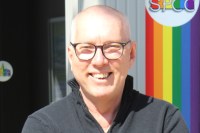
Woodstein Media Podcast Episode 15: Bruce Duncan Skeaff assesses the SPCC role in the 2SLGBTQIA+ community and promotes Stratford’s “big gay 2023”

In episode 15, Bruce Duncan Skeaff, the president and chair of the board at the Stratford Pride Community Centre, assesses how things have been going as it approaches the one-year mark since opening. He discusses what he had expected the role of the community centre would have been for the local 2SLGBTQIA+ community and how it has been utilized as a resource to help people.

Woodstein Media Podcast Episode 11: Dunstan Bruce contemplates aging & purpose via Interrobang, Am I Invisible Yet? and Chumbawamba film

On episode 11, ex-Chumbawamba member Dunstan Bruce speaks about the contemplation of his place in this world through his contemporary art, whether it’s singing with his new band Interrobang‽, treading theatre stages in his one-person show, Am I Invisible Yet? or scrutinizing his place in the Chumbawamba legacy in the film, I Get Knocked Down. (All images copyright Dunstan Bruce)

Woodstein Media Podcast episode one: Joe Amero talks harm reduction

Joe Amero, a social worker in the Toronto shelter system, discusses his history of drug use and harm reduction. Joe discusses how his brother Harry’s overdose affected his family and how he dealt with his feeling through a one-person show he wrote titled Blood, the Drug User Liberation Front’s compassion club actions where they distribute a clean supply of drugs to help stop overdoses due to drugs contaminated with Fentanyl, Drugs! The Musical, the Telethon! and songs by Hobo Banditos, the Hip Hop band he and Harry were in.

Joe Amero brings depth of lived experience to harm reduction in Toronto shelter system

This is the final feature in a three-part series diving into aspects of the opioid pandemic, the overdose crisis, whatever you wish to call it. It is a public health crisis which became exacerbated by the COVID-19 pandemic.

According to Canada’s Public Health database, there was a 95 percent increase in apparent opioid toxicity deaths from April 2020 to March 2021, with a total of 7,224 deaths, compared to 3,711 deaths from April 2019 to March 2020. Since then, deaths have remained high.

These statistics were published in March 2022 and only went as far as September 2021, but by that point, 5,368 apparent opioid toxicity deaths had occurred. This is approximately 20 deaths per day. For a similar timeframe in the years before the pandemic, there were between 7 in 2016 and 12 in 2018 deaths per day.